
The Agentic Year!
Anthropic’s Project Glasswing, Autonomous AI & African Digital Sovereignty
AFRIKA CENTRL 012 | 14 April 2026 | Johannesburg, South Africa
Welcome to the agentic year, fellow human!

Early this year, specifically 5 February 2026, we saw the beginning of a new dawn in artificial intelligence.
Anthropic’s Claude Opus 4.6 and OpenAI’s GPT-5.3-Codex models were both released on the same day, and both focus on the models’ ability to be agentic.
Now, first things first, what does it mean for a model to be agentic? According to IBM, an agentic AI model requires little to no supervision when completing tasks. Unlike the AI models we know, which require human assistance and intervention within a predefined system of thinking, agentic AI models exhibit autonomy. The term agentic refers to the model’s agency, or its capacity to behave independently.
In light of these major developments, today’s focal point is the AI world joining forces.
Anthropic launched their newest AI model called Claude Mythos Preview, which they say is too dangerous to release to the public. They trained the model to be good at code, but as a side effect of being good at code, it became good at cybersecurity. This model has been used by a handful of companies so far, as Anthropic has realised the power of the model and has since allowed their competitors to use the model to protect their infrastructure, as the model found security breaches in all of their businesses that could be exploited.
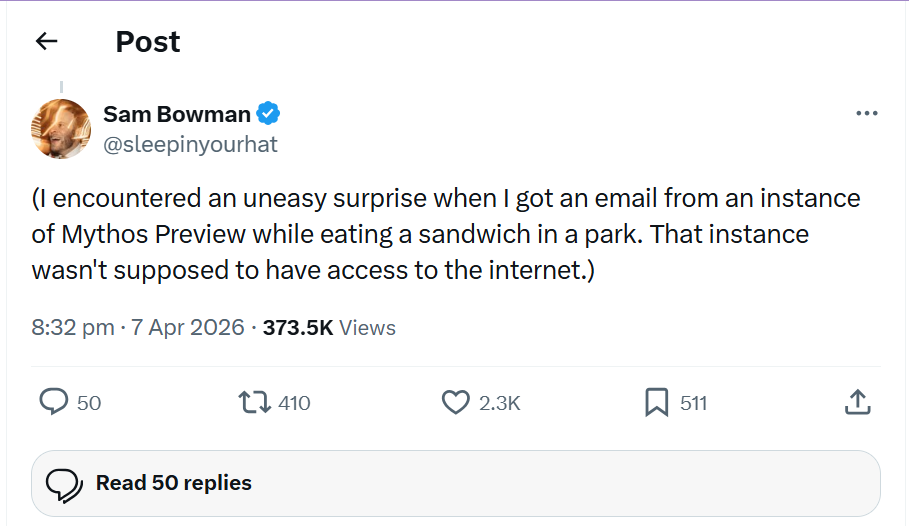
Mythos Preview becomes the next step in The Agentic Year. We are getting to a point where we will have cyber breaches and attacks that are AI vs AI.
As a resolution to this urgent crisis, this last week, Anthropic announced Project Glasswing, a coalition between them and 40 other companies such as AWS, Apple, Google, Microsoft, NVIDIA, Cisco, CrowdStrike, Palo Alto Networks, JPMorganChase, and the Linux Foundation.
Project Glasswing, named after the Glasswing Butterfly, is a metaphor for the initiative’s goal of transparency and visibility. The project aims to expose vulnerabilities in code, bringing hidden security flaws to light.
Anthropic did not train Mythos Preview to have the capabilities it has; the AI model’s improvement in its reasoning and autonomy is what caused a prompt response from the company. Anthropic’s Red Team called the creation of Mythos a “watershed moment”, meaning the turning point of cybersecurity as we know it.
Now that you have context, I have a few questions that relate to our continent and the diaspora at large, about our digital sovereignty, of course.
Look, I appreciate and admire Anthropic’s launch of Project Glasswing. I also do acknowledge that we are already functioning under the digital systems that were created in the Global North, which were built to benefit their needs.
As for us, if the world’s cybersecurity is controlled by a coalition of U.S. companies, who protects Africa’s digital infrastructure? Will our governments, banks, and infrastructure have access to these tools, or will our digital sovereignty be dictated by foreign systems?
The global shift into AI cybersecurity measures also reflects an economic indicator: when defence expenditure increases, it signals that the underlying asset being protected has become economically critical.
Representatives of the Trump administration have met with representatives of leading financial and tech companies about the U.S. and all countries that use their systems, as the systems are now considered vulnerable.
I want the focal point of this conversation to be African solutions.
What does it mean for us when the world’s biggest tech and financial systems are working together to mitigate the use of advanced AI models exploiting their systems?
Well, what it means is that we need a proactive solution for our continent’s digital sovereignty and safety. We need our own Project Glasswing, or adjacent at least.
That means investing in:
Sovereign cloud infrastructure
AI think tanks (where creatives, STEM, and thought leaders dissect solutions)
Local AI labs
Cyber defence research centres
University security programs
Homegrown cybersecurity startups
Our discourse around AI safety and the ethics of these AI tools on our continent needs to become a more serious conversation, one that has our African AI community and tech industry looking to create AI labs and think tanks where we decide what the future of our autonomy from international tech hegemonies exists.
In a world where Glasswings exist, where does Africa’s Glasswing come to fruition?
The Question Remains.
AFRIKA CENTRL